3D-Printed Mirrors Resist Laser Damage With Water Cooling
SHANNON, CLARE, IRELAND, October 13, 2026 /EINPresswire.com/ -- As the semiconductor industry pushes towards smaller,
Press Release Disclaimer: This is a press release distributed through the XPR Media network. It has not been independently verified by our newsroom.

SHANNON, CLARE, IRELAND, October 13, 2026 /EINPresswire.com/ —
As the semiconductor industry pushes towards smaller, faster and more powerful microchips, researchers have developed an innovative 3D-printed copper mirror that could help overcome a critical challenge in advanced chip manufacturing: preventing powerful lasers from overheating and damaging precision optical components.
In a study published in Opto-Electronic Advances, researchers at Tongji University, China, demonstrated that integrating a 3D-printed water-cooling system into high-performance laser reflectors increased their resistance to laser-induced damage by approximately 60%, while significantly reducing heat accumulation.
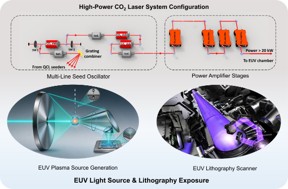
The breakthrough could have important implications for extreme ultraviolet (EUV) lithography, the sophisticated technology used to manufacture cutting-edge semiconductor chips. EUV systems rely on high-power carbon dioxide (CO₂) lasers to generate ultraviolet light, but intense laser exposure can cause mirrors to overheat, deform and deteriorate, potentially compromising optical performance and manufacturing reliability.
To address this challenge, the research team combined advanced 3D printing, copper-based thermal management and precision optical coatings to create a reflector capable of withstanding demanding laser conditions.
Using laser powder bed fusion, the researchers fabricated a copper mirror containing internal water-cooling channels. They then applied a copper surface-modification layer and a multilayer reflective coating incorporating gold, germanium and zinc sulfide, achieving over 99.5% reflectance at a wavelength of 10.6 micrometres.
Experimental results revealed substantial improvements. Under laser irradiation, the mirror’s measured surface temperature decreased from 84.2°C without cooling to just 45°C with water cooling, a reduction of approximately 53%. Meanwhile, its laser-induced damage threshold increased from 8,488 to 13,581 W/cm², representing a 60% improvement.
Computer simulations also showed that water cooling reduced peak-to-valley thermal deformation by approximately 75%, helping preserve the mirror’s optical shape under intense heating.
Importantly, the researchers established that copper surface modification outperformed nickel, demonstrating the crucial role of thermal conductivity in protecting high-power laser optics.
Beyond semiconductor manufacturing, the findings highlight the potential of additive manufacturing and integrated liquid cooling for developing more resilient optical components in high-power laser systems and other precision industrial equipment.
Although further development is needed before industrial deployment, this research offers a promising route towards more reliable, thermally stable laser mirrors, potentially supporting the next generation of advanced semiconductor manufacturing technologies.
Keywords: 3D printing cooling system, surface modification, 10.6 μm reflective coating, thermal control, laser-induced damage threshold
# # # # # #
Opto-Electronic Advances (OEA) is a high-impact, open access, peer reviewed SCI journal with an impact factor of 22.4 (Journal Citation Reports 2024). OEA has been indexed in SCI, EI, DOAJ, Scopus, CA and ICI databases, and expanded its Editorial Board to 41 members from 17 countries.
# # # # # #
More information: http://www.oejournal.org/oea
Editorial Board: http://www.oejournal.org/oea/editorialboard/list
All issues available in the online archive (http://www.oejournal.org/oea/archive).
Submissions to OEA may be made using ScholarOne (https://mc03.manuscriptcentral.com/oea).
ISSN: 2096-4579
CN: 51-1781/TN
Contact Us: oea@ioe.ac.cn
Twitter: @OptoElectronAdv (https://twitter.com/OptoElectronAdv?lang=en)
WeChat: OE_Journal
# # # # # #
Jiao HF, Jiang BB, Niu XS et al. 3D-printed copper water cooling system assisted fabrication of 10.6-μm high-power CO2 laser resistance reflectors. Opto-Electron Adv 9, 250297 (2026). DOI: 10.29026/oea.2026.250297
Opto-Electronic Advances Editorial Office
Opto-Electronic Advances
oea@ioe.ac.cn
Legal Disclaimer:
EIN Presswire provides this news content “as is” without warranty of any kind. We do not accept any responsibility or liability
for the accuracy, content, images, videos, licenses, completeness, legality, or reliability of the information contained in this
article. If you have any complaints or copyright issues related to this article, kindly contact the author above.

Media gallery