Major Richard Star Act Fight Enters 2026 Midterms as 54Kvets Revisits PACT Act Battle
Washington, D.C, District of Columbia Oct 1, 2026 (Issuewire.com) As the November 3 midterm elections approach,
Press Release Disclaimer: This is a press release distributed through the XPR Media network. It has not been independently verified by our newsroom.
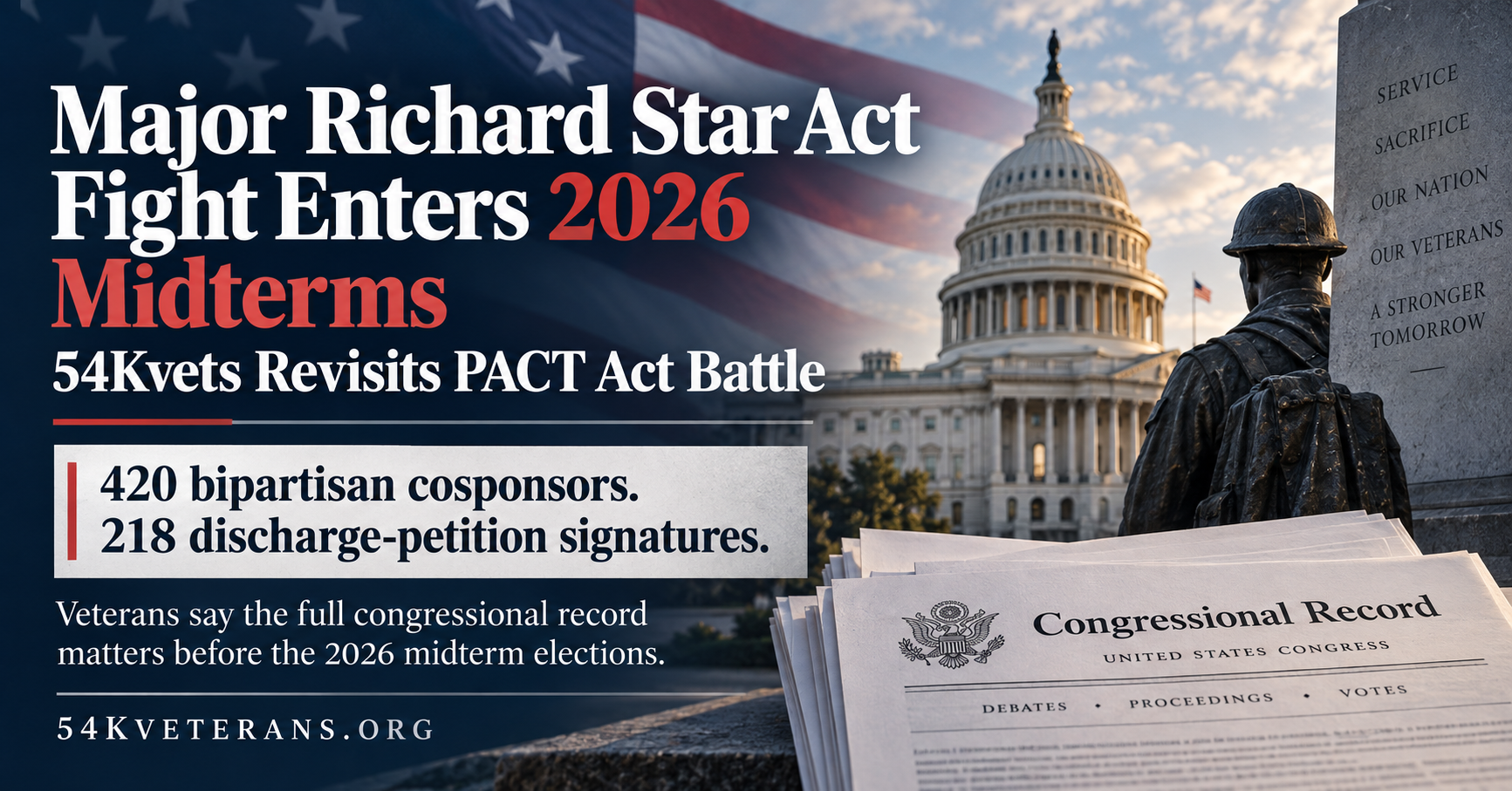

Washington, D.C, District of Columbia Oct 1, 2026 (Issuewire.com) As the November 3 midterm elections approach, combat-injured retirees fighting for the Major Richard Star Act are looking back at another veterans-benefit battle Congress ultimately resolved with overwhelming bipartisan support: the PACT Act.
The bills address different injustices.
The PACT Act expanded health care and disability benefits for veterans exposed to burn pits and other toxic substances. The Major Richard Star Act addresses qualifying Chapter 61 retirees whose military careers ended because of combat-related disabilities but who can lose military retired pay because of the offset against VA disability compensation.
For those retirees, the injustice is simple: military service leaves them disabled, their careers end early, and earned retirement pay can then be reduced because they also receive compensation for those disabilities.
The Major Richard Star Act has 340 House cosponsors and 80 Senate cosponsors. On September 15, H.Res. 1247 reached the required 218 discharge-petition signatures, placing the discharge motion on the House calendar.
Yet the fight remains unresolved.
Veterans Remember What Came Before the PACT Act Victory
Today, the PACT Act is remembered as a major bipartisan veterans law.
Veterans remember the fight before the final vote.
The Senate approved the PACT Act 84-14 in June 2022. Six weeks later, a key cloture vote failed 55-42. Veterans responded publicly. Some camped outside the Capitol. Veterans organizations demanded action, and Jon Stewart became one of the most visible advocates pressing Congress to finish the legislation.
Six days later, the Senate approved final passage 86-11.
The chronology does not establish that public pressure caused any individual senator to change a vote. It does establish something simpler:
The final 86-11 vote does not tell the whole story.
The final vote is what history remembers, but veterans remember what happened before it, said Shane Junkert, retired Navy Senior Chief, Chapter 61 combat-injured veteran and organizer of 54Kveterans. They remember the setback. They remember veterans outside the Capitol. They remember having to keep fighting even after overwhelming bipartisan support already existed.
Four Senate Objections Despite Broad Bipartisan Support
The Senate record already contains another chapter in the Major Richard Star Act fight.
During separate efforts to advance S. 1032 through unanimous consent or secure a time-certain vote, four Republican senators objected: Roger Wicker in October 2025, Ron Johnson in March 2026, Rand Paul in June, and Thom Tillis later that month.
The Senate record documents the repeated efforts to advance the Major Richard Star Act.
Those objections now sit alongside 80 Senate cosponsors and the broader congressional record surrounding the legislation.
A Competing Path: The Take Care of Americas Veterans Act
The Major Richard Star Act is also no longer the only legislative approach being debated.
Since June, congressional committee leaders have promoted the Take Care of Americas Veterans Act (TCAVA), an omnibus veterans package containing an alternative concurrent-receipt proposal.
The distinction matters.
TCAVA uses a lesser of calculation that can limit retirement restoration for some under-20-year Chapter 61 retirees compared with the approach contained in H.Res. 1247. It also includes Section 108, which would change future VA disability-rating rules involving sleep apnea and tinnitus claims filed after enactment.
The Veterans of Foreign Wars and Disabled American Veterans have publicly opposed Section 108.
For 54Kvets, TCAVA therefore becomes another piece of the record: not simply whether lawmakers say they support combat-injured retirees, but which legislative approach they support and what that approach actually contains.
Why the PACT Act History Matters Again
The PACT Act shows why supported the bill can be an incomplete description of a congressional fight.
Several senators associated today with TCAVA changed positions during the 2022 PACT Act process. Marsha Blackburn, Bill Cassidy, Kevin Cramer and Cindy Hyde-Smith supported the PACT Act in June, opposed the July cloture motion, and supported final passage in August.
Others remained consistent. Jerry Moran and John Boozman supported it through those stages; Thom Tillis opposed it through those stages.
54Kvets is not assigning motives to those votes.
It is documenting them.
People can decide for themselves what the record means, Junkert said. Our responsibility is to make sure they can see the whole recordnot just whichever vote becomes convenient to remember years later.
Major Richard Star Act Accountability Before the 2026 Midterms
Before the November 3 midterm elections, the Major Richard Star Act record already includes 420 bipartisan cosponsors, 218 discharge-petition signatures, four Senate objections, competing legislative approaches and years without final passage.
54Kvets says it is preserving each part separately: cosponsorship, petition signatures, competing bills, procedural actions and eventual roll-call votes.
We learned something from the PACT Act, Junkert said. If the Major Richard Star Act eventually passes overwhelmingly, that final vote should not erase everything combat-injured veterans had to do to get there.
Campaign statements fade. Congressional records do not.
Congress will eventually write the final vote on the Major Richard Star Act.
Veterans are keeping the rest of the record.
Media Contact
54Kveterans (54Kvets)
817-771-3577
489 Army Drive box 24130
Source :54Kveterans (54Kvets)
This article was originally published by IssueWire. Read the original article here.